
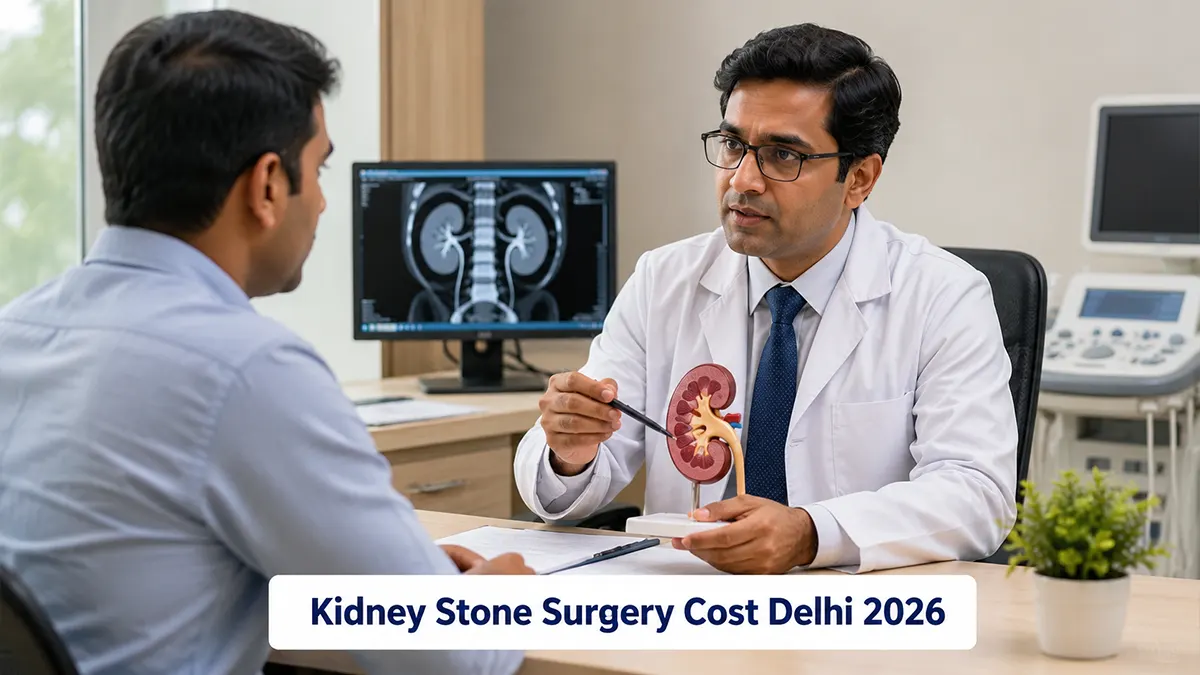
Kidney stone surgery cost in Delhi can vary considerably depending on the stone’s size and location, the procedure recommended, hospital type, surgeon fees, room category, tests, medicines and whether additional treatment is required. Current Delhi cost listings show a broad range, with different estimates for ESWL, ureteroscopy/laser treatment, RIRS and PCNL. For example, Practo currently lists kidney stone treatment in Delhi at about ₹17,000–₹1.50 lakh overall, while procedure-specific published estimates vary substantially by provider.
For a practical 2026 estimate, patients may encounter costs from roughly ₹35,000 to ₹2 lakh or more, depending on the procedure and hospital. This is an indicative range, not a fixed Delhi tariff. The final quotation should be confirmed with the treating hospital after imaging and urological evaluation.
This guide explains kidney stone surgery prices in Delhi, procedure-wise costs, what a hospital package may include, additional expenses, government options, insurance coverage and how to compare quotations. The structure and editorial requirements for this guide follow the supplied TopCityHub medical-cost brief.
Kidney Stone Surgery Cost in Delhi: Quick Snapshot
| Treatment / Cost Factor | Indicative Delhi Cost in 2026 |
|---|---|
| Overall kidney stone treatment | ₹17,000–₹1,50,000+ |
| ESWL / Shock Wave Lithotripsy | ₹35,000–₹60,000+ |
| URS / URSL with laser | ₹55,000–₹1,00,000+ |
| RIRS / Flexible Ureteroscopy | ₹90,000–₹1,65,000+ |
| PCNL | ₹70,000–₹1,10,000+ |
| Pre-treatment tests | Usually several thousand rupees |
| Medicines and consumables | Depends on treatment |
| Stent-related procedures | Additional cost may apply |
Important: These are indicative figures compiled from currently published Delhi pricing information, not a standardized city-wide tariff. Practo lists ESWL at approximately ₹33,000–₹55,000, PCNL at ₹1 lakh–₹1.10 lakh and laser lithotripsy at ₹25,000–₹35,000 in one Delhi cost dataset. Pristyn Care’s August 2026 Delhi estimates list ESWL at ₹35,000–₹60,000, URSL at ₹55,000–₹98,200, RIRS at ₹90,000–₹1.63 lakh and PCNL at ₹70,000–₹98,200.
A separate Delhi estimate published by Apollo Spectra gives a broader range of ₹59,900–₹1.69 lakh, demonstrating why patients should not treat any single website’s figure as a guaranteed quotation.
Kidney Stone Surgery Cost in Hyderabad 2026: RIRS, PCNL, URS & ESWL Prices
What Is the Average Kidney Stone Surgery Cost in Delhi in 2026?
There is no single “average” price that applies to every kidney stone patient.
The procedure makes a major difference:
- ESWL may be appropriate for selected stones and can sometimes be performed without a conventional surgical incision.
- URS/URSL removes ureteral stones using an endoscope passed through the urinary tract, often with laser fragmentation.
- RIRS uses a flexible ureteroscope to reach stones inside the kidney.
- PCNL is commonly considered for larger kidney stones and involves accessing the kidney through a small tract through the back.
Current Delhi estimates illustrate this spread. Pristyn Care reports average figures of ₹47,500 for ESWL, ₹76,600 for URSL, ₹1,26,500 for RIRS and ₹84,100 for PCNL.
These numbers should be viewed as published estimates rather than a Delhi-wide medical tariff.
Kidney Stone Surgery Cost in Delhi by Procedure
1. ESWL Cost in Delhi
Extracorporeal Shock Wave Lithotripsy (ESWL) uses externally generated shock waves to break a kidney or urinary stone into smaller fragments that can pass through the urinary tract.
A current Delhi estimate from Pristyn Care puts ESWL at approximately ₹35,000–₹60,000, with an average of ₹47,500. Practo lists approximately ₹33,000–₹55,000 in its Delhi treatment-cost data.
ESWL is not suitable for every stone. Stone size, location, composition, density and the patient’s anatomy can affect whether it is an appropriate option.
The European Association of Urology notes that shock-wave lithotripsy, ureteroscopy and PCNL are different treatment options whose suitability depends on stone characteristics.
Dental Implant Cost in Hyderabad 2026: Complete Price Guide
2. URS / URSL Laser Surgery Cost in Delhi
Ureteroscopy (URS) involves passing a small scope through the urinary tract to reach the stone. Laser energy may be used to fragment the stone.
Pristyn Care currently lists approximately ₹55,000–₹98,200 for URSL in Delhi.
Another Delhi estimate from Apollo Spectra lists laser ureteroscopic lithotripsy at approximately ₹59,900–₹1.18 lakh.
The final price can depend on:
- Stone location
- Number of stones
- Stone size
- Laser equipment used
- Anesthesia
- Hospital stay
- Stent placement
- Surgeon and hospital charges
- Additional procedures
3. RIRS Cost in Delhi
Retrograde Intrarenal Surgery (RIRS) is a minimally invasive procedure in which a flexible ureteroscope is used to reach stones inside the kidney.
Pristyn Care currently estimates RIRS at approximately ₹90,000–₹1.63 lakh in Delhi, with an average of about ₹1.26 lakh. Apollo Spectra publishes a higher estimate of approximately ₹1.46–₹2.01 lakh.
The difference between these published estimates highlights an important point: hospital-specific pricing can vary significantly.
RIRS may involve specialized equipment and laser technology, which can increase the overall cost.
Chemotherapy Cost in Hyderabad 2026: Per-Cycle Price, Total Treatment Cost & Insurance
4. PCNL Cost in Delhi
Percutaneous Nephrolithotomy (PCNL) is a minimally invasive procedure in which the surgeon creates a small access tract into the kidney to remove larger stones.
Pristyn Care currently lists PCNL at approximately ₹70,000–₹98,200 in Delhi, with an average of about ₹84,100. Apollo Spectra lists approximately ₹83,860–₹1.10 lakh.
PCNL is particularly relevant for larger kidney stones. European urology guidelines recommend PCNL as a first-line treatment for renal stones larger than 2 cm in appropriate patients.
Because PCNL is more invasive than ESWL, hospital stay, anesthesia, monitoring and postoperative care can contribute substantially to the total bill.
What Determines the Cost of Kidney Stone Surgery in Delhi?
Several factors can change the final kidney stone surgery price.
1. Stone Size
Larger stones may require more complex procedures or multiple treatment sessions.
2. Stone Location
A stone in the kidney may require a different approach from one located in the ureter.
3. Number of Stones
Multiple stones may require longer procedures or staged treatment.
4. Procedure Selected
ESWL, URS, RIRS and PCNL have different equipment, anesthesia and hospitalization requirements.
5. Hospital Type
Government hospitals, private hospitals and premium tertiary-care hospitals may have substantially different billing structures.
6. Surgeon Fees
Consultation and procedure fees can vary according to the surgeon, specialty and hospital.
7. Room Category
Private rooms, twin-sharing rooms and higher-category rooms can change the daily hospital cost.
8. Diagnostic Testing
Ultrasound, CT scans, blood tests, urine testing and other investigations may be required before treatment.
9. Anesthesia
The type and duration of anesthesia can affect the procedure bill.
10. Stent and Consumables
A ureteral stent or other medical consumables may create additional expenses.
11. Length of Hospital Stay
A straightforward procedure may involve a short stay, whereas complications or more complex treatment may require longer hospitalization.
12. Emergency Treatment
Emergency admission for obstruction, severe pain or infection may produce a different cost from planned treatment.
Appendix Surgery Cost in Hyderabad (2026): Complete Guide
Kidney Stone Surgery Cost Breakdown
The total bill is usually made up of several components rather than one surgery fee.
| Cost Component | What It May Include |
|---|---|
| Doctor/Surgeon fee | Consultation and procedure fee |
| Hospital charges | OT, facility and nursing services |
| Anesthesia | Anesthetist and anesthesia-related charges |
| Diagnostic tests | Blood, urine, ultrasound, CT and other tests |
| Room | Bed and accommodation charges |
| Medicines | Antibiotics, pain medicines and other prescribed drugs |
| Consumables | Catheters, tubing and procedure-specific supplies |
| Laser/equipment | Applicable to certain procedures |
| Stent | Placement and later removal, if required |
| Follow-up | Consultation, imaging or additional treatment |
One Delhi cost estimate published by Practo gives examples of pre-surgery costs around ₹4,000, surgery charges around ₹84,000–₹89,250, consultation around ₹600 and a two-day room estimate of ₹8,000, although these figures should not be treated as a universal package.
Stroke Treatment Cost in Hyderabad 2026: Hospital Charges, Surgery, Insurance & Recovery
Government vs Private Hospital Kidney Stone Treatment in Delhi
| Factor | Government Hospital | Private Hospital |
|---|---|---|
| Treatment cost | Often lower or subsidized | Usually higher |
| Waiting time | May be longer depending on demand | Often more flexible |
| Room options | Generally more limited | Wider range |
| Specialist availability | Depends on hospital and department | Depends on hospital |
| Insurance | Scheme/insurance dependent | Often cashless if networked |
| Government schemes | May be available | Available only where applicable/empanelled |
| Equipment | Varies by facility | Varies by facility |
| Package pricing | May follow government rates/schemes | Hospital-specific |
Neither option is automatically better for every patient. The medically appropriate procedure, availability of urological expertise, urgency, affordability and insurance status should all be considered.
Government Rates Can Be Different From Private Hospital Prices
Government-administered reference tariffs can provide useful context but should not be confused with what every private patient will pay.
For example, the Delhi Directorate General of Health Services publishes CGHS Tier-I rates. Its published table lists ESWL at ₹36,550–₹49,450, depending on the applicable hospital classification, and RIRS/flexible ureteroscopy at ₹53,550–₹72,450. It also lists Holmium YAG stone lithotripsy at ₹64,600–₹87,400.
These are CGHS rates for eligible beneficiaries and the specified tariff framework, not a universal retail price for kidney stone surgery in Delhi.
Is Kidney Stone Surgery Covered by Health Insurance?
Kidney stone treatment may be covered by health insurance when the procedure is medically necessary and the policy terms permit coverage.
However, coverage depends on the individual policy.
Before admission, check:
- Whether the hospital is in your insurer’s network
- Whether cashless treatment is available
- Whether pre-authorization is required
- Waiting-period rules
- Pre-existing disease provisions
- Co-payment
- Deductibles
- Room-rent limits
- Procedure-specific sub-limits
- Non-medical expenses
- Consumables coverage
- Stent or device coverage
- Coverage for follow-up procedures
Insurance approval should never be assumed.
Coverage depends on the policy terms, medical necessity, insurer approval and hospital network status.
Government Health Schemes in Delhi
Ayushman Bharat PM-JAY
Delhi has implemented Ayushman Bharat PM-JAY, with the Delhi Health & Family Welfare Department maintaining an official PM-JAY portal. The department’s page was updated on August 20, 2026.
Delhi’s 2026–27 budget documents also state that PM-JAY has been implemented in Delhi and that coverage has been expanded to certain additional beneficiary categories.
Eligibility, package availability, empanelled hospitals and authorization requirements should be checked through the official scheme system before treatment.
Delhi Arogya Kosh
Delhi Arogya Kosh (DAK) is another important program for eligible patients. The Delhi Directorate General of Health Services states that DAK can provide financial assistance of up to ₹5 lakh for treatment in government hospitals for eligible patients, subject to the scheme’s requirements.
The current DAK information also specifically states that eligible patients requiring kidney-stone surgery can be referred in specified circumstances when the necessary facility is unavailable in the treating government hospital.
Patients should verify current eligibility, documentation, referral requirements and participating hospitals directly with the Delhi government before relying on any scheme for payment.
When Is Kidney Stone Surgery Medically Considered?
Not every kidney stone requires surgery.
Treatment depends on factors including:
- Stone size
- Stone location
- Symptoms
- Urinary obstruction
- Infection
- Kidney function
- Stone growth
- Previous treatment
- Patient preference and clinical circumstances
The European Association of Urology lists stone growth, obstruction, infection and symptomatic stones among indications for active removal.
For selected smaller stones, observation or medical management may be possible. When active removal is needed, the appropriate procedure depends on the stone and patient characteristics.
ESWL vs URS vs RIRS vs PCNL
| Procedure | General Use | Invasiveness | Hospital Stay |
|---|---|---|---|
| ESWL | Selected kidney/ureter stones | Least invasive | Often outpatient/day care |
| URS/URSL | Many ureteral stones | Minimally invasive | Often short stay |
| RIRS | Selected kidney stones | Minimally invasive | Usually short stay |
| PCNL | Larger kidney stones | More invasive | Usually longer than ESWL/URS |
The choice should be made by a qualified urologist after reviewing imaging and other clinical factors.
For larger renal stones, particularly stones over 2 cm, European guidelines recommend PCNL as the first-line approach in appropriate cases.
What Is Usually Included in a Kidney Stone Surgery Package?
A hospital package may include some combination of:
- Surgeon fee
- Anesthesia
- Operating-room charges
- Hospital bed
- Nursing
- Routine medicines
- Standard consumables
- Procedure equipment
- Basic postoperative monitoring
But package inclusions differ between hospitals.
Do not assume that a quoted “surgery cost” represents the final bill.
Ask for a written estimate showing exactly what is included and excluded.
How to Compare Kidney Stone Surgery Quotations
Before choosing a hospital, ask these questions:
- Is the surgeon’s fee included?
- Is anesthesia included?
- Is the operating-room fee included?
- Are medicines included?
- Are diagnostic tests included?
- Is the laser/equipment charge included?
- Is the stent included?
- Is stent removal included?
- How many hospital days are included?
- What is the room category?
- What happens if the hospital stay becomes longer?
- What happens if an additional procedure is required?
- Are complications billed separately?
- Does insurance require pre-authorization?
- Is the hospital in the insurer’s cashless network?
- Are follow-up consultations included?
A written package estimate is usually more useful than comparing only the headline surgery price.
What Can Cause an Unexpected Increase in the Hospital Bill?
Additional expenses can arise from:
- Longer hospitalization
- Additional imaging
- Repeat blood or urine tests
- Infection treatment
- Complications
- ICU monitoring
- Additional medicines
- Additional procedure sessions
- Stent placement or removal
- Higher room category
- Additional consumables
- More complex stone treatment
These possibilities do not mean complications will occur. They simply explain why a final bill can differ from an initial estimate.
Recovery After Kidney Stone Surgery
Recovery depends on the procedure and the patient’s health.
ESWL can often involve a relatively short recovery period. URS and RIRS commonly involve short hospital stays, while PCNL may require a longer period of observation and recovery.
Published Delhi treatment information from Pristyn Care lists approximately:
- ESWL: outpatient treatment with 1–2 days of recovery
- URS: 1–2 days of recovery and approximately 1–2 hospital days
- PCNL: approximately 2–7 days of recovery and 2–4 hospital days
Actual recovery can be shorter or longer depending on the procedure, stone burden, medical condition and postoperative course.
Frequently Asked Questions
1. How much does kidney stone surgery cost in Delhi in 2026?
There is no single fixed price. Current published Delhi estimates range broadly from around ₹35,000 to ₹2 lakh or more, depending on the procedure and hospital. ESWL, URS, RIRS and PCNL have different costs.
2. What is the cheapest kidney stone treatment in Delhi?
ESWL can be less expensive than some endoscopic procedures in selected cases, but the cheapest treatment is not necessarily the medically appropriate one. The procedure depends on stone size, location, composition and other factors.
3. How much does PCNL cost in Delhi?
Current published estimates include approximately ₹70,000–₹98,200 from Pristyn Care and ₹83,860–₹1.10 lakh from Apollo Spectra. Actual hospital quotations can differ.
4. How much does RIRS cost in Delhi?
Published Delhi estimates vary significantly. Pristyn Care currently lists approximately ₹90,000–₹1.63 lakh, while Apollo Spectra lists approximately ₹1.46–₹2.01 lakh.
5. Does health insurance cover kidney stone surgery?
It may. Coverage depends on medical necessity, policy terms, waiting periods, exclusions, sub-limits, insurer authorization and network-hospital status. Confirm coverage before admission.
6. Does Ayushman Bharat cover kidney stone treatment in Delhi?
Delhi has implemented AB PM-JAY, but whether a particular kidney stone procedure is covered depends on the applicable package, beneficiary eligibility, authorization and empanelled facility. Verify through the official PM-JAY system.
7. Can Delhi Arogya Kosh help with kidney stone surgery?
The Delhi government states that eligible patients requiring kidney-stone surgery can receive assistance/referral under specified DAK conditions. Eligibility and referral requirements must be verified with the treating government hospital.
8. Is RIRS more expensive than ESWL?
Generally, published Delhi estimates show RIRS costing more than ESWL. However, the appropriate treatment should be based on clinical factors rather than price alone.
9. Are medicines included in the surgery cost?
Not always. Some hospital packages include standard medicines and consumables, while others bill them separately. Ask the hospital for a written list of inclusions.
10. Can the kidney stone procedure require another session?
Yes. Some treatments may require additional sessions depending on stone characteristics and the response to treatment. The EAU notes that SWL can require multiple treatments in some circumstances.
11. How can I reduce unexpected kidney stone surgery expenses?
Ask for a detailed written quotation, confirm package inclusions, check insurance pre-authorization, ask about stent and follow-up costs, and clarify what happens if the hospital stay or treatment needs to be extended.
12. Does every kidney stone require surgery?
No. Some stones can be monitored or managed without active removal. Surgery or another active stone-removal procedure may be considered when factors such as obstruction, infection, symptoms or stone growth make intervention appropriate.
Kidney Stone Surgery Cost: Delhi vs Hyderabad vs Mumbai vs Bangalore vs Chennai
Kidney stone treatment prices can differ across major Indian cities because of variations in hospital infrastructure, surgeon fees, room categories, diagnostic charges, equipment, and the complexity of the procedure. There is no single standardized kidney stone surgery price across India.
Current published cost data shows that the overall treatment ranges can overlap substantially between Delhi, Hyderabad, Mumbai, Bengaluru and Chennai. Therefore, patients should compare the same procedure and package inclusions, rather than choosing a city based only on the lowest advertised price.
City-Wise Indicative Kidney Stone Treatment Cost
| City | Published Overall Treatment Range | Published Average* |
|---|---|---|
| Delhi | ₹17,000–₹1,50,000 | ₹61,351 |
| Hyderabad | ₹17,000–₹1,50,000 | ₹61,351 |
| Mumbai | ₹30,000–₹1,50,000 | ₹80,000 |
| Bangalore | ₹30,000–₹1,50,000 | ₹80,000 |
| Chennai | ₹17,000–₹1,50,000 | ₹61,351 |
*These figures are from current published Practo cost pages and should be treated as indicative online estimates rather than standardized city-wide surgery prices.
ESWL Cost Comparison
| City | Indicative ESWL Cost |
|---|---|
| Delhi | ₹33,000–₹55,000 |
| Hyderabad | ₹28,000–₹47,000 |
| Mumbai | ₹31,000–₹52,000 |
| Bangalore | ₹30,000–₹50,000 |
| Chennai | ₹27,000–₹45,000 |
These published figures show that ESWL prices can be relatively similar across the five cities, although individual hospitals may quote different prices depending on equipment, stone characteristics and package inclusions.
PCNL Cost Comparison
For PCNL, published Practo estimates commonly show an average around ₹1.05 lakh in Delhi, Hyderabad, Mumbai, Bangalore and Chennai, with the wider procedure-specific ranges differing by city and source.
However, another Delhi estimate lists PCNL at approximately ₹47,500–₹1.89 lakh, while Chennai’s published estimate extends from approximately ₹47,500–₹1.71 lakh. This demonstrates why a single online figure should not be treated as a final quotation.
Which City Is Cheaper for Kidney Stone Surgery?
There is no reliable basis for saying that Delhi, Hyderabad, Mumbai, Bangalore or Chennai is universally the cheapest city for kidney stone surgery.
The final price can change because of:
- Procedure selected
- Stone size and location
- Number of stones
- Surgeon fee
- Hospital category
- Room type
- Anesthesia
- Laser or other equipment
- Stent and consumables
- Diagnostic tests
- Length of hospital stay
- Insurance coverage
- Complications or additional procedures
For example, current published data shows Mumbai and Bangalore with higher overall average figures on one Practo comparison, while procedure-specific prices can be quite similar between cities.
For patients comparing Delhi with Hyderabad, Mumbai, Bangalore or Chennai, the most useful approach is to request quotations for the same procedure with the same inclusions. A ₹70,000 quotation that excludes the stent, medicines, room charges and follow-up may ultimately cost more than a ₹90,000 all-inclusive package.
Important Note About City-Wise Cost Data
Online medical-cost databases use different methodologies and may display different ranges for the same city. For example, Practo’s individual city pages currently show substantially different overall averages depending on the page and dataset displayed.
Therefore, TopCityHub does not treat these figures as official government tariffs or fixed hospital prices. They are useful for understanding the broad price landscape, but patients should obtain a current written estimate from the hospital before treatment.
How TopCityHub Interprets Kidney Stone Surgery Prices
The prices in this guide should be understood as indicative published estimates, not as a survey of every Delhi hospital.
Because online prices can differ significantly between providers, TopCityHub recommends using published figures as a starting point and obtaining a current written quotation from the hospital where treatment is being considered.
For example, current published Delhi sources show:
- Practo: overall kidney stone treatment approximately ₹17,000–₹1.50 lakh
- Pristyn Care: procedure-specific estimates ranging from approximately ₹35,000 for lower-end ESWL estimates to ₹1.63 lakh for higher-end RIRS estimates
- Apollo Spectra: overall published range of approximately ₹59,900–₹1.69 lakh, with some individual procedures extending above that range
The variation itself is important information for patients: there is no reliable single Delhi-wide kidney stone surgery price.
Author Information
Written by: TopCityHub Editorial Team
Medically Reviewed : This article has been prepared using publicly available medical, hospital, government and healthcare information sources. Medical information should be reviewed and updated against current clinical guidance before publication.
Last Updated: August 29, 2026
Medical Review Date: August 29, 2026
Medical Disclaimer
Medical costs are indicative and can vary by hospital, doctor, procedure type, location, insurance coverage, medical condition and additional treatment requirements. Readers should confirm the current estimate, inclusions and insurance coverage directly with the hospital or healthcare provider. This article is for informational purposes and does not replace professional medical advice.